Should You Rent or Buy a Home? The Real Math Behind the Decision
Buying isn't always better than renting. Learn the actual math behind the rent vs. buy decision, including break-even timelines, opportunity cost, and what the experts get wrong.
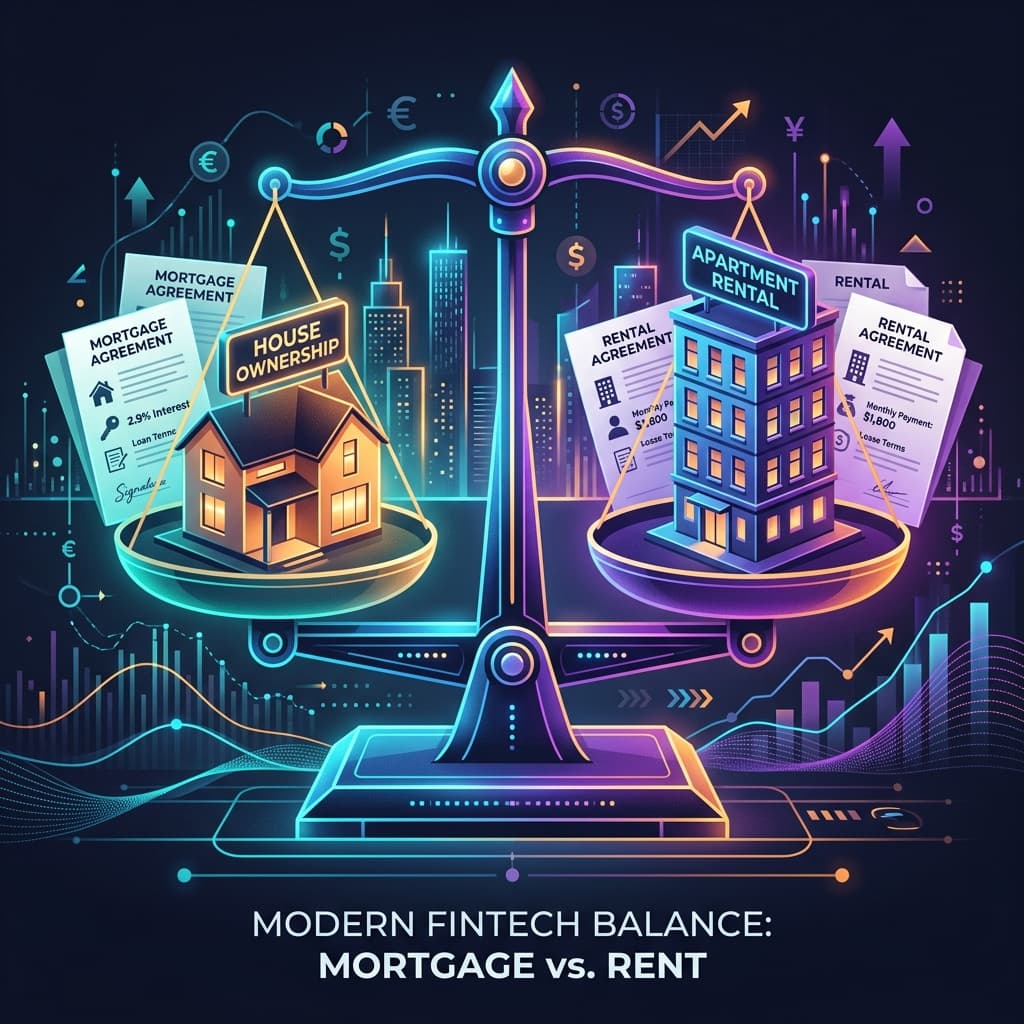
Should You Rent or Buy a Home? The Real Math Behind the Decision
Few pieces of conventional financial wisdom are as stubbornly repeated — and as frequently wrong — as: "Renting is throwing money away."
The implication is that every rental payment disappears into a void while every mortgage payment builds equity. The reality is far more nuanced. Buying a home is not always the smarter financial move, and the rent-vs-buy decision depends heavily on how long you plan to stay, what local market prices look like, and what you'd do with your down payment money if you didn't use it on a house.
Let's break down the actual math.
The Hidden Costs of Homeownership
When you rent, your monthly payment is your monthly cost. Full stop.
When you buy, your "mortgage payment" is just one line item in a much longer list. The true cost of homeownership includes:
- Mortgage P&I: Principal + interest, the only part that builds equity
- Property taxes: Typically 1–2% of the home's value per year
- Homeowner's insurance: $1,000–$3,000/year depending on location
- Private Mortgage Insurance (PMI): ~0.5–1.5% of the loan annually if you put less than 20% down
- Maintenance: Experts recommend budgeting 1–2% of the home's value per year (a $400,000 home → $4,000–$8,000/year just in upkeep)
- HOA fees: Can run $200–$600/month in many communities
- Closing costs: 2–5% of the purchase price, paid at the start and again when you sell
Use our Mortgage Payment Calculator to see a detailed breakdown of what your monthly payment actually includes — you may be surprised how different the "total housing cost" number is from the advertised mortgage rate.
What Renting Actually Buys You
Renters aren't throwing money away — they're buying:
- Flexibility — You can move for a job, a relationship, or a cheaper city with 60 days' notice
- Freedom from maintenance costs — A broken water heater is your landlord's problem
- Liquidity — Your down payment money stays accessible, potentially invested and growing
- Protection from a falling market — If home values drop, renters are unaffected
The opportunity cost of a down payment is real. If you put $80,000 into a home as a 20% down payment, that $80,000 is no longer in the market. Invested in a diversified index fund at a historical average of 7%, that $80,000 would become approximately $157,000 over ten years — without you doing anything. Your home would need to appreciate significantly just to match that baseline.
The Break-Even Timeline
The rent-vs-buy decision is primarily a question of time. Buying a home involves substantial upfront costs (down payment, closing costs) and ongoing costs (maintenance, taxes). It typically takes five to seven years for the financial benefits of homeownership to outweigh the costs of renting, all else being equal.
If you plan to live in a city for less than five years, renting is almost always the smarter financial decision. If you plan to stay for ten or more years, buying often makes strong financial sense — especially in markets with historically strong appreciation.
The "Price-to-Rent Ratio" Test
A quick way to assess your local market:
Price-to-Rent Ratio = Home Price ÷ Annual Rent
For example: A home priced at $400,000 in a city where comparable rentals cost $2,000/month ($24,000/year):
$400,000 ÷ $24,000 = Price-to-Rent ratio of 16.7
Interpreting the ratio:
- Below 15: Buying tends to make more financial sense
- 15–20: Either option can make sense depending on your situation
- Above 20: Renting typically provides better financial value
In many high-cost-of-living markets (San Francisco, New York, London, Sydney), this ratio exceeds 30 or even 40, making renting the economically superior choice for most people who aren't planning to stay for 10+ years.
When Buying Is Clearly the Right Move
Buying a home makes strong financial sense when:
- You plan to stay for at least 5–7 years
- You can afford at least a 10–20% down payment without depleting your emergency fund
- Your total housing costs (P&I + taxes + insurance + maintenance) are no more than 28–32% of your gross income
- Local price-to-rent ratios are in a reasonable range (below 20)
- You've eliminated high-interest consumer debt first
When Renting Is Clearly the Smarter Move
Renting is the better financial choice when:
- You expect to move within 3–4 years
- You'd have to deplete your savings or take on consumer debt to make the purchase work
- Local markets have price-to-rent ratios above 25
- You value flexibility and mobility over stability
- The monthly cost to own is significantly higher than to rent an equivalent home
The Non-Financial Factor
This analysis is purely mathematical. But homes aren't just financial assets — they're places people build families, put down roots, and create stability. Those things have real value that doesn't show up in a spreadsheet.
The goal isn't to tell you not to buy a home. The goal is to make sure that if you buy, you do it because you genuinely want to — with eyes open to the true costs — not because someone told you renting is "throwing money away."
Ready to run the mortgage numbers for a home you're considering? Use our Mortgage Payment Calculator to see the full monthly cost, including taxes and PMI, in under 60 seconds.
Disclaimer: This article is for educational purposes only and does not constitute financial advice.
Share this article
Further Reading
Ready to run the numbers for your situation?
Browse all free calculators →